Author: throwntogetherness

  • Reconnecting with soil to reconnect with a different kind of economy

    People harvesting green leafy vegetables from damp, dark soil
    People harvesting green leafy vegetables from damp, dark soil

    People in Aotearoa New Zealand spend more and more time indoors, and less time connecting with te taiao than our ancestors did. For many of us, we don’t think of ourselves as connected to the land in a practical way — although we may feel more abstractly connected to places and spaces. How do we build relationships with the land and places that are intimate and knowing? Why should we?

    Scholars have talked about the idea of ‘metabolic rift’ — the disconnect that many urban people have when it comes to the metabolic cycle. Our food is produced far away from us, and our food scraps are taken away from us to landfill or other (hopefully better) places. Even our shit is taken away through pipes to who knows where. This mean we aren’t really viscerally connected to the cycles of production, consumption and decomposition that keep us all alive. The metabolic rift can be bigger than this too: in Aotearoa New Zealand our soils produce foods for export and the waste from those foods is handled elsewhere in the world — but we then have to import fertilisers to keep that system going! The ‘circle’ of the metabolism is broken.
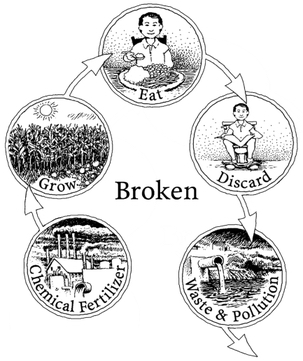
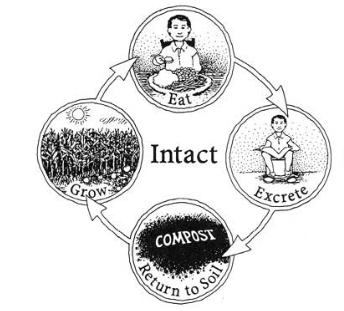
    This is a big problem for our economies and our whenua. When there is no circularity to our production, consumption and decomposition, we are disconnected from the effects of our actions on the land. It’s also a big problem for our understanding of ourselves as economic and environmental actors. How can we see ourselves as relating intimately to the environment if we are encouraged to see ourselves as part of a massive import export global system machine?

    When there is no circularity to our production, consumption and decomposition, we are disconnected from the effects of our actions on the land.

    In my work, I’m interested in the relational side of economies, how we understand ourselves as economic and environmental beings, and how that affects the way we act in the world. I have had the privilege to study an urban farm where young people and others are invited into a relationship with the soil through practices of composting and gardening. They are invited to close the metabolic rift quite literally by eating and even shitting on site in a composting toilet! But they are also invited to close the metabolic rift by coming into an attentive and observant relationship with te taiao, the natural world.
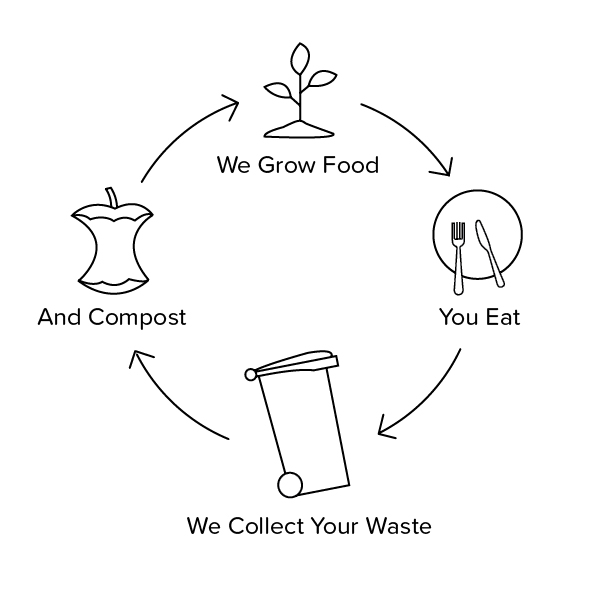
    Reconnecting with the soil in this way creates space for reconnecting with oneself as a different kind of economic actor. It invites us to understand ourselves and our role in the economy as relational and as more active producer and activist, and less of a passive consumer. Sasha Goburdhone and myself wrote a commentary on this for New Zealand Geographer, which just came out this week. I invite you to check it out, and leave a comment to get the conversation going. What do you think about the idea of metabolic rift? Is it a useful analysis?

  • Annual reporting

    Detail from painting by Inge Flinte — hopefully it will feature on the cover of one of the books coming out!

    It’s hard to believe that it’s been a year already since I started at Massey and began working on this project fulltime. Recently I had to complete an annual report, which provides a nice opportunity to reflect on what I have been doing. Here are the highlights:

    Transforming the way we think about economies

    • Finished off and submitted Caring for Life: A postdevelopment politics of infant hygiene. It’s now in production with University of Minnesota Press and will be available by the end of the 2023. While infant hygiene might not seem related to economies, the book develops an approach to studying places built on pluriversal thinking. Nappy-free hygiene practices in the Global South are understood as important innovations for Global North communities who need to rethink their resource use.
    • Finished off an submitted Introducing Human Geographies, 4th edition, co-edited with Paul Cloke, Mark Goodwin, Junxi Qian and Andy Williams. This global textbook is in production with Routledge, and was a complete revision and redesign of the text that included a diverse range of authors from all over the world. I worked particularly on the ‘Collaborations’ section, which envisions the next generation of geographic education and research.
    • Taught the Aotearoa node of the intensive winter school Researching Postcapitalist Possibilities. PhD and early career scholars from NZ and Australia converged on Palmerston North for 10 days of immersive learning in poststructural action research, community economies, and researching with postcapitalist possibilities in mind.

    Inventorying diverse economies with postcapitalist potential

    Case studies of transition

    • The in-depth case studies have emerged from partnered work from my Building Better Homes, Towns and Cities work.
    • We have completed in-depth case studies of composting and organic waste initiatives, which we published this year.
    • We have completed an in-depth report on the wellbeing outcomes of the work of Life in Vacant Spaces in a post-disaster context in Ōtautahi Christchurch.
    • Did some experimental work with a quantitative version of a Community Economy Return on Investment tool, with the help of a wonderful intern from Norway. We will continue to work on developing this in both quantiative and qualitative versions as part of this research programme.
    • I have begun a new case study of Christian and post-Christian postcapitalist subjectivities and activism, with ethics approval, a book contract and co-author all lined up!

    Key findings in 2023

    • Communities are already investing in transition to postcapitalist and caring economies and there is extensive innovation that is not yet present in the literature. Part of the issue is that social innovation is not always recognised, particularly if it is done in marginalised and low-income groups, regions or nations.
    • Global interconnections are being made, particularly between networks in the Global South, that have well-developed bottom-up theories of economic change.
    • Subjectivities (or sense of self as an actor) play a role in community investment – we have found this in particular with alternative waste infrastructure that contributes to more circular community economies.
    • New metrics are needed and desired by community organisations who want to represent the transformative work they do outside of monetary frameworks.
  • Recruiting a PhD student interested in transitioning to caring economies

    Recruiting a PhD student interested in transitioning to caring economies

    One of the cool things about getting some funding for this project is the ability to offer a scholarship! You can read more about my advertised scholarship here, including how to apply. I’m keen for people to bring their own passions, interests and communities to the project.

    The whole process highlighted how our economies are in dire need of transition, however. The funding was approved in 2021, and since then the PhD scholarship rates were increased (yay!), but I was not allowed to increase the scholarship rate for the one I am offering (boo!). However, I have managed to ring-fence some funding for PhD fieldwork, including international travel if appropriate, and a paid part-time research assistant job on this project. While this is still not ideal, it does mean that any part-time work the PhD student is doing will be relevant to their PhD – rather than going to work in a petrol station or supermarket or work in an unrelated course tutoring.

    I guess this also highlights the things that we can and do already do to create opportunities for care ‘in the meantime’. And how much we need to make this the norm, if PhD students are able to survive on more than two-minute noodles. If you would like to find out more about the scholarship, please get in touch via my Massey email.

    Photo by Ekrulila on Pexels.com