Tag: community economies

  • Podcast Drop: Postcapitalist politics through the sites and practices of life’s work

    Podcast Drop: Postcapitalist politics through the sites and practices of life’s work

    It was an immense privilege to record this first podcast in an ongoing collaboration with Professor Tara Brabazon in the build up to my new book on postcapitalist economies of care. This first episode revisits a book chapter from 2015, where I first began to engage with the concepts of life’s work, care, social reproduction and postcapitalist possibilities. Check it out here, on Youtube, or wherever you get your podcasts.

  • 🌿 Transitions in Action: A Field Guide to the Wellington Region’s Emerging Future

    🌿 Transitions in Action: A Field Guide to the Wellington Region’s Emerging Future

    We wrote this guide because we could feel something stirring across the region.

    Recently I was part of a project documenting awesome projects in the Greater Wellington Region. In our work as researchers, community collaborators, planners, and advocates, we kept coming across people doing the quiet, determined, and deeply hopeful work of transition. These included composters and kai growers, local energy innovators, housing cooperatives, council staffers working behind the scenes, artists hosting place-based experiments, iwi-led projects regenerating whenua. As someone born in Wellington and who grew up in Wairarapa, I was really keen to connect with projects in this region but also to connect them with each other!

    Often, these efforts were siloed or invisible to each other. But taken together, they point to something larger: an emerging transition infrastructure already in motion. Transitions in Action: An Urban and Regional Transitions Guide for Te Upoko o te Ika / Wellington is our attempt to document, honour, and connect these efforts.


    What the guide is (and isn’t)

    It’s not a plan. It’s not a blueprint. We explored a few different ideas for titles (I suggested ‘look book’), but it was Amanda that came up with the idea of a ‘field guide’.

    So it’s a field guide—something that invites attention, orientation, and learning. It draws on interviews, workshops, and mapping work to identify over 50 projects across six transition domains: housing, energy, mobility, ecosystems, economy, and community.

    To me, what is important is that these are not hypothetical futures—they’re already underway. And they’re reshaping our shared sense of what’s possible here.

    What we’ve learned

    Writing this guide affirmed a few things we suspected, and clarified many things we hadn’t yet articulated. A few key insights:

    • Transitions are already happening, but they’re uneven, precarious, and sometimes invisible to themselves.
    • Place matters. Transition in Wellington looks different than in other regions—it’s shaped by wind, faultlines, iwi relationships, governance structures, harbour edges, and long-standing networks of resistance and repair.
    • Community and institutional work are entangled. The most promising initiatives weren’t either grassroots or top-down—they blurred those lines.
    • Transitions need time and infrastructure. Many of these projects operate on goodwill and temporary resourcefulness. Without scaffolding—funding, policy shifts, relational infrastructure—they risk burning out or being co-opted.

    Who we wrote it for

    We wrote this guide for people already doing the work, to help them find each other. It was so awesome to see a range of the people who feature in the book turn up to the launches and meet each other!

    We also wrote it for funders, public servants, and elected officials—those who say they want climate action or community wellbeing, but often don’t know where to start. The guide shows what’s already in motion, what’s needed, and where policy or funding could shift to support grassroots capacity without overriding it. We have had such a great response from local and central government — with Masterton councillor Stella Lennox, Wellington City Councillor Yadana Saw, MPs Celia Wade-Brown and Tamatha Paul appearing at our two launches!

    Finally, we wrote it for ourselves. To better understand the ecology of transition in our home region. To see the patterns, the synergies, the tensions, and the possibilities.

    What’s next?

    Our hope is that the guide becomes a resource for conversation and connection. That it helps to legitimise and amplify the work already being done. And that it invites deeper reflection on what kinds of transitions we’re part of—and for whom.

    We’re already hearing from local councils, community groups, and educators who want to use it in their work. And we’re in ongoing conversations with collaborators about how this guide might seed similar efforts in other regions.


    You can download the full guide here:
    📘 Transitions in Action (PDF)

    You can find out more about the authors here:

    Amanda Yates | Gradon Diprose | Kelly Dombroski | Thomas Nash

    The book was launched in Wellington in March and in Wairarapa in May

  • What holds a community together?

    What holds a community together?

    Plain language summary for Communities of Care: The Nitty-Gritty of Commons-Work. Available from https://www.communityeconomies.org/publications/articles/communities-care-nitty-gritty-commons-work

    One of the questions I keep coming back to in my work is: what really holds a community together? Not the big, flashy ideals, but the everyday stuff or what we might call the nitty-gritty. The washing-kids’-bums, negotiating-how-to-share-a-space, holding-a-meeting-with-too-much-cake kind of stuff. That’s where I think community is made—in the messy work of care.

    In my recent piece for Azimuth: Critical Care, I dive into what I’ve learned from two community-based projects in Aotearoa New Zealand:
    Te Hiko Centre for Community Innovation in Porirua, and
    Life in Vacant Spaces (LiVS) in post-earthquake Ōtautahi Christchurch.

    Both are examples of what I call communities of care—where people aren’t drawn together by identity or ideology, but by the shared work of caring for something in common. Like many researchers into this area, I’ve been calling that kind of work commoning.

    Care Is Not (Just) a Feeling

    We often talk about care like it’s a soft feeling—but care is also labour. It’s exhausting, it’s beautiful, and it’s sometimes thankless, but it’s labour. In Te Hiko, that looked like local people working together to support financial wellbeing—asking, how do we plug the drain that’s sucking resources from our community? For LiVS, it looked like artists and organisers breathing life into vacant lots with murals, performances, and small everyday interventions that helped Christchurch slowly heal.

    Both projects navigated two big tensions:

    1. Who’s in and who’s out? Communities that care have to negotiate boundaries. Open enough to welcome new energy, but with some shape so the work can actually happen.
    2. Care as a ‘practice’ that’s both affect and labour. There’s the heart-side of care—emotional connection, beauty, grief, joy. And there’s the sweat—coordinating projects, holding meetings, applying for funding. They’re both essential, and often unequally valued.

    The Commons Is in the Doing

    What binds these projects together is not ownership, identity, or even a shared vision—it’s the doing. The repeated, practical, awkward, loving, sometimes fraught ongoing practice of caring together.

    That kind of commons-care is never perfect. It’s never resolved. It’s always in negotiation—who shows up, who does the dishes, who gets heard, who’s exhausted, who’s thriving.

    But it’s precisely in that nitty-gritty negotiation that community is made and remade.

    Why It Matters

    In a world that feels increasingly fragmented, it’s tempting to look for clean answers: clear boundaries, easy fixes, grand theories. But maybe what we need is to get better at sitting in the mess. At holding complexity. At making space for real care—care that’s not just soft and fuzzy, but material, tiring, healing, and profoundly political.

    I wrote this piece to offer a grounded, hopeful, and realistic account of what communities of care look like in practice. Not perfect. But very much possible. I hope you enjoy it!

    When it comes down to it, the ‘nitty-gritty’ of care is rarely idyllic, and involves difficult collaborations and relationships with others. Whether it is washing a child, developing a constitution for a community group, or restoring a wetland, the practical details of caring are never completely straight-
    forward. Yet it is exactly this nitty-gritty negotiation of the details of caring for shared resources, spaces or matters of concern that holds communities together, rather than boundaries or shared identity.

    Dombroski, 2024, p27
  • Why we should talk about economies rather than ‘the economy’

    Why we should talk about economies rather than ‘the economy’

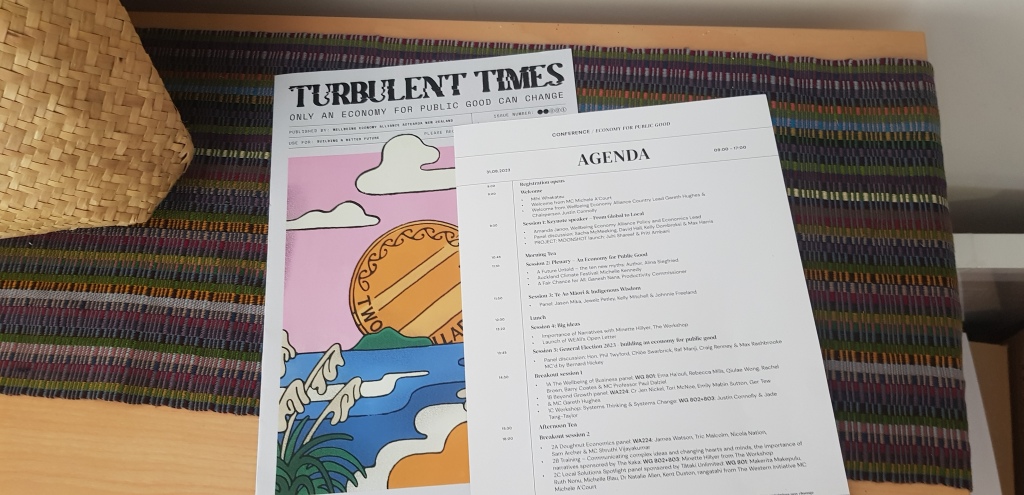
    Below is the script for my response to Amanda Janoo’s talk at the Economy for Public Good Conference, August 31st at AUT. The conference was organised by the Wellbeing Economy Alliance of Aotearoa. Thanks to Gareth Hughes for the invite.

    Tēnā koutou katoa, ngā mihi nui kia koutou.

    E ngā mana whenua o te rohe nei, ko Ngāti Whātua ki Orakei, tēnā koutou.

    E ngā kaikōrero o te ra, tēnā koutou.

    E ngā tāngata katoa kua tae mai nei kei te tautoko te kaupapa o tēnei ra, nōku te hōnore ki te tu, ki te mihi ki a koutou katoa.

    No Wairarapa ahau, he tangata tiriti ahau. No Kotiwana ōku tūpuna. E noho ana ahau ki Papaioea, e mahi ana ki Te Kunenga ki Purehūroa Massey University. Ko Kelly Dombroski tōku ingoa.

    Mauri ora ki a tātou katoa.

    Kia ora everyone, it’s such an honour to be here today with all of you at this event looking at wellbeing economies – and I use it in the plural – I will get back to that later.

    Amanda, thanks for your talk today laying out how we got here in terms of economic thinking and practices. There are two responses I’d like to make in support of your talk – both for situating this kaupapa in Aotearoa but also about the way we think about economies more generally.

    Have you noticed already that I’m talking about economies in the plural?

    I’m a geographer, and the big thing that we are into is this idea of ‘place’. Place matters. Where you are in the world matters. It makes a difference. And although we have experienced incredible globalisation of our economies in the past century, place still matters for economies. I’m going to ask for a small change to our language here today – to speak not of ‘the economy’ as if it was this big coherent immoveable and solid thing, but to speak of economies – and to speak of economies as diverse, place-based, interconnected yes, but also unique and uniquely ours.

    Even now, some of you are thinking – yes of course ‘the economy of New Zealand’. Others are thinking ‘but the system!! The system!! It’s all connected!!’. YES it is all connected, but kao, it is not one economy necessarily. We all participate in interconnected but place-based economies. As Amanda has alluded to, it is their ubiquity across the world that our hope for further change lies.

    So the first step for those of us interested in wellbeing and economies is this: to recognise the diverse range of economic activities already in play in our place-based economies. The vast majority of these economic activities lie below the waterline – that is, they are not measured by GDP, they are not studied by many economists, they are not considered when economic planners think about how we might try to secure housing or food for our whānau.  These are the gifting, social surplus, commoning, solidarity, hapū, community and volunteering economic activities – noncapitalist labour, noncapitalist enterprises, noncapitalist transactions, property and finance. These are already here if we look below the waterline. I’ve interviewed and researched dozens of community economy groups over the last decade, and done in depth studies into what they’re doing.

    For wellbeing economies in Aotearoa, the first step is to inventory what we already have in our place-based and regional economies at hand. These are like the ingredients in our pantry. We can cook up a boring meal based on one big lump of potatoes while everything else rots, or we can pull out and support all the decent ingredients that we have already at hand.

    The meal has some parameters: it has to be nutritious and filling, but it also has to meet cultural requirements of our places– to feed our guests without shame, to include important foods that have meaning to us. It has to be ethical too – to not be made up of foods that are destroying our lands and seas and peoples lives. It also has to be affordable, and hopefully to not be wasteful. The parameters of dignity, purpose, particpation, care for the natural world that Amanda mentioned are good start points. If we think of our economies as pantries rather than massive singular systems, we can also think of ourselves as ethical collective actors in our place-based economies. What meal we cook up is also a result of the decisions that we collectively make – they are not automated laws of the market or economy that force us to act to only in one way, as if we were rational economic robots constantly outsourcing the costs of our lives to others if given half a chance. We can think a bit more about what these meals might look like.

    If we think of our economies as pantries rather than massive singular systems, we can also think of ourselves as ethical collective actors in our place-based economies.

    Kelly Dombroski

    So for me – and this is my main point: we have to talk about economies in the plural, to map out the ingredients we have to work with already, to build on that and make decisions about combining these economic activities into economies at a lot of different scales and in different places around the motu. And this is what our mahi has been doing – in Ōtautahi, and now in Te Whanganui a Tara – inventorying the best ingredients that we already have and writing them up and sharing them around.

    It is about collectively working with what we have in full recognition to the diversity of answers to the question “how do we live well together”? with the answer partly being ‘start where we are, with what we have at hand’.

    Nō reira, ka tika te kōrero: mauri mahi, mauri ora – let’s be the people that do that mahi of working out how to live well together in these challenging times.
  • Evaluating holistic wellbeing

    Evaluating holistic wellbeing

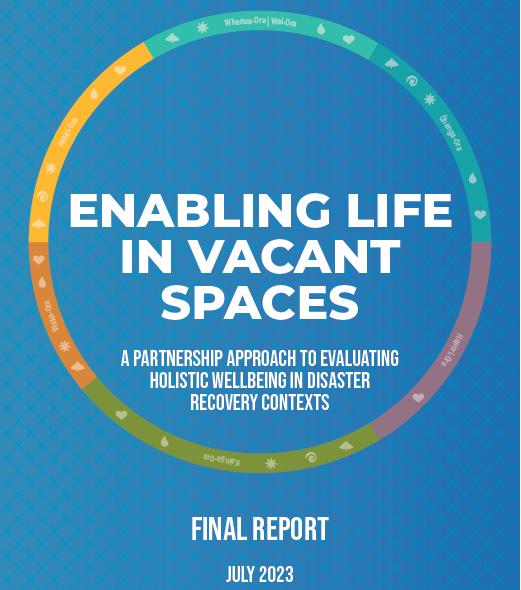
    Measuring and communicating the holistic wellbeing outcomes of community intiatives is often difficult, time-consuming and can miss important intentions and outcomes. Our recent report documents our 3 year project with Christchurch organisation Life in Vacant Spaces (LiVS), trialling a method of evaluating wellbeing outcomes of 27 of the more than 700 projects supported by LiVS over ten years.

    Enabling Life in Vacant Spaces: A partnership approach to evaluating holistic wellbeing in disaster recovery projects reports on our experiment with a “Community Economy Return on Investment Approach” combined with a holistic urban wellbeing tool based on evidence-based urban wellbeing actions for change. We found that this way of assessing holistic wellbeing ‘returns’ on investment could help communicate outcomes in a more holistic way.

    However, we found that the method still relies on some expert input and some more time-consuming qualitative and relational methods.

    Next steps are to develop then test a community-based ‘how to’ guide that helps community groups develop their own methods for assessing their holistic wellbeing returns. The report will be a useful start point for community groups, local government and funding agencies to think about how they approach evaluation for both human and environmental outcomes with reference to the ‘inputs’ of investment — both financial investment and investments of time and energy!

    This report was part of a the Building Better Homes, Towns and Cities Urban Wellbeing National Science Challenge. The first two years of my Transitioning to Caring Economies through Transformative Community Investment research programme specifies collaboration with the Urban Wellbeing stream. The report was authored by Kelly Dombroski, Gradon Diprose, Matt Scobie and Amanda Yates.