Tag: caring economies

  • The Desire to Write Grows with Writing

    The Desire to Write Grows with Writing

    “The desire to write grows with writing” is a quote attributed to Desiderius Erasmus of Rotterdam, a prolific writer, theologian and humanist in the 15th Century. I have not been able to find the source of the quote, but it continues to circulate because it seems like the truth of it is widely recognised by writers.

    It has been on my mind lately as I have committed to writing 250 words a day on a new book, tentatively titled Postcapitalist Economies of Care. The 250 words started out as difficult — I needed to figure out a structure, a point, then write within that structure and point, which usually required some reading. But as I have gone on, for 3 weeks now, it has become easier. In fact, I come to sit in my home study in both early morning and late afternoon in the weekend just for the pure pleasure of it, even if I have already managed the 250 words.

    It’s a strange experience really. I think the desire to write grows with writing as you start to figure out what you are trying to say then find the time and the way to say it. Right now, I’m only halfway through my chapter structure, but already at my word count for it — what that means is that I’m quite motivated to get back to it, get on with the next section and get to the end of the piece of work so I can then return to edit and sharpen.

    I would also add that for me, the desire to write also grows with reading. When I read books, especially, I feel quite motivated to interact with their arguments and figure out how they differ or complement what I am thinking.

    Finally, I’ve been working on a variety of interesting projects for a decade, and working on a new book is an opportunity to reflect on what they all mean and how they all help me consider my broader project of transitioning to postcapitalist economies of care. Watch this space!

  • 🌿 Transitions in Action: A Field Guide to the Wellington Region’s Emerging Future

    🌿 Transitions in Action: A Field Guide to the Wellington Region’s Emerging Future

    We wrote this guide because we could feel something stirring across the region.

    Recently I was part of a project documenting awesome projects in the Greater Wellington Region. In our work as researchers, community collaborators, planners, and advocates, we kept coming across people doing the quiet, determined, and deeply hopeful work of transition. These included composters and kai growers, local energy innovators, housing cooperatives, council staffers working behind the scenes, artists hosting place-based experiments, iwi-led projects regenerating whenua. As someone born in Wellington and who grew up in Wairarapa, I was really keen to connect with projects in this region but also to connect them with each other!

    Often, these efforts were siloed or invisible to each other. But taken together, they point to something larger: an emerging transition infrastructure already in motion. Transitions in Action: An Urban and Regional Transitions Guide for Te Upoko o te Ika / Wellington is our attempt to document, honour, and connect these efforts.


    What the guide is (and isn’t)

    It’s not a plan. It’s not a blueprint. We explored a few different ideas for titles (I suggested ‘look book’), but it was Amanda that came up with the idea of a ‘field guide’.

    So it’s a field guide—something that invites attention, orientation, and learning. It draws on interviews, workshops, and mapping work to identify over 50 projects across six transition domains: housing, energy, mobility, ecosystems, economy, and community.

    To me, what is important is that these are not hypothetical futures—they’re already underway. And they’re reshaping our shared sense of what’s possible here.

    What we’ve learned

    Writing this guide affirmed a few things we suspected, and clarified many things we hadn’t yet articulated. A few key insights:

    • Transitions are already happening, but they’re uneven, precarious, and sometimes invisible to themselves.
    • Place matters. Transition in Wellington looks different than in other regions—it’s shaped by wind, faultlines, iwi relationships, governance structures, harbour edges, and long-standing networks of resistance and repair.
    • Community and institutional work are entangled. The most promising initiatives weren’t either grassroots or top-down—they blurred those lines.
    • Transitions need time and infrastructure. Many of these projects operate on goodwill and temporary resourcefulness. Without scaffolding—funding, policy shifts, relational infrastructure—they risk burning out or being co-opted.

    Who we wrote it for

    We wrote this guide for people already doing the work, to help them find each other. It was so awesome to see a range of the people who feature in the book turn up to the launches and meet each other!

    We also wrote it for funders, public servants, and elected officials—those who say they want climate action or community wellbeing, but often don’t know where to start. The guide shows what’s already in motion, what’s needed, and where policy or funding could shift to support grassroots capacity without overriding it. We have had such a great response from local and central government — with Masterton councillor Stella Lennox, Wellington City Councillor Yadana Saw, MPs Celia Wade-Brown and Tamatha Paul appearing at our two launches!

    Finally, we wrote it for ourselves. To better understand the ecology of transition in our home region. To see the patterns, the synergies, the tensions, and the possibilities.

    What’s next?

    Our hope is that the guide becomes a resource for conversation and connection. That it helps to legitimise and amplify the work already being done. And that it invites deeper reflection on what kinds of transitions we’re part of—and for whom.

    We’re already hearing from local councils, community groups, and educators who want to use it in their work. And we’re in ongoing conversations with collaborators about how this guide might seed similar efforts in other regions.


    You can download the full guide here:
    📘 Transitions in Action (PDF)

    You can find out more about the authors here:

    Amanda Yates | Gradon Diprose | Kelly Dombroski | Thomas Nash

    The book was launched in Wellington in March and in Wairarapa in May

  • Caring for Life: New book release challenges us to learn from places often considered ‘undeveloped’

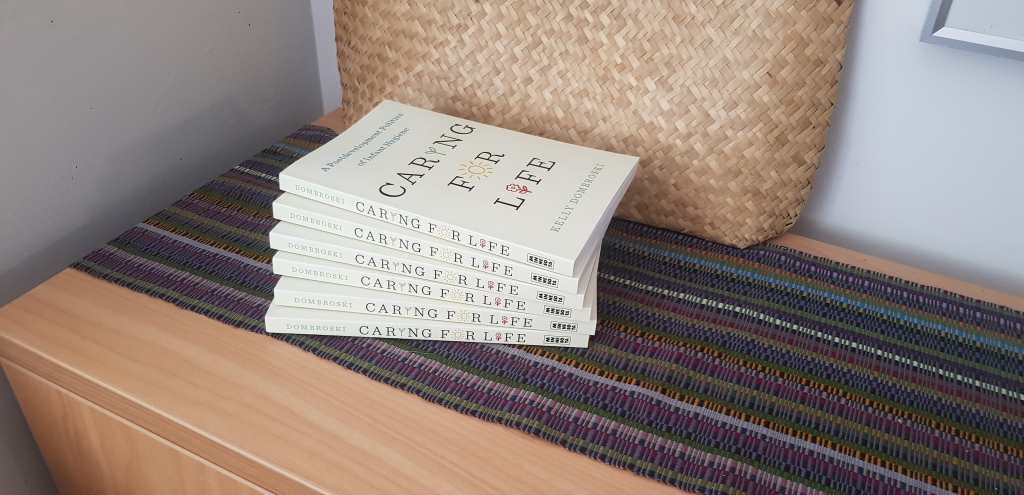
    Caring for Life: New book release challenges us to learn from places often considered ‘undeveloped’

    In February 2006, 6 months pregnant, I left Palmerston North NZ for Canberra, Australia to pursue a PhD with Katherine Gibson (of JK Gibson-Graham). Thus began a journey of research and learning in Australia, China, Aotearoa NZ, through the birth of four children and homes in five different cities. And in February 2024, some 18 years later, I celebrate the monograph that emerged from all that work!

    When I went into the project 18 years ago, I was really interested in how the processes of Westernisation and globalisation were playing out unevenly around the world. I was particularly interested in pockets of resistance to corporate globalisation. In my fieldwork in the far west of China in the province of Qinghai, I studied the relationship between the local nappy-free infant hygiene practice, space, place and cultures of health and wellbeing. During that time, I discovered a whole online community of westerners also trying to learn the nappy-free infant hygiene practice but without the support of their local environments or cultures. In both groups, there was a resistance to the use of disposable nappies, and the deliberate cultivation of embodied practices of hygiene that required less material (and plastic) stuff.

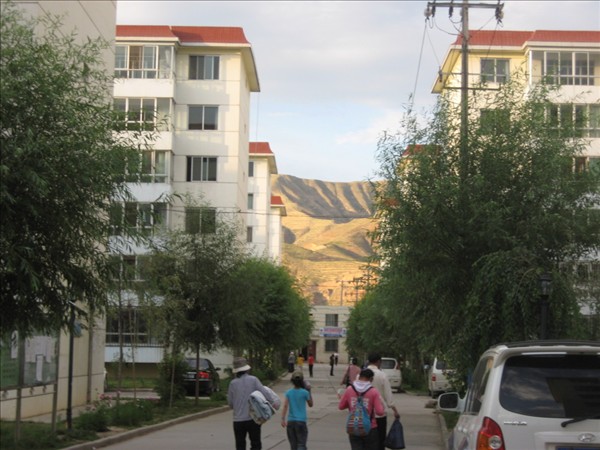
    Fieldwork was conducted in the city of Xining, in Qinghai province in the far west of China

    Hygiene is social, material and spatial

    As a book project, Caring for Life: A postdevelopment politics of hygiene speaks more to our post-pandemic hygienes, as well as the broader question of how does social change happen. In the revisions made for the monograph, I significantly rewrote and retheorised most of the material to build an argument about hygiene assemblages.

    Hygiene assemblages is a term referring to the social, material, cultural and spatial practices that come together to keep hygiene. In the Qinghai examples, these assemblages gathered around strong social and spatial practices — caregivers learned the specific signals for baby’s wee and poop, and held them out over appropriate places — wee against a tree, on the concrete, on the tiles, or over a drain. Poop over a newspaper, a basin, a toilet or a pile of ash from the fire (in rural areas). But they worked to keep hygiene nevertheless. In the Australian examples, caregivers were trying to learn these signals too, but with less historical and cultural knowledge to draw on. Their assemblages gathered around the material aspects of the practice: potties, bags, nappies, wipes, toilets, containers and more.

    Of course, all hygiene assemblages have both social and material practices, and all have a spatiality and cultural component. What I was interested in was the possibilities of learning and assembling new hygiene practices and assemblages through cross-cultural learning. Could these practices from the far west of China influence hygiene assemblages in Aotearoa, Australia and other places in the West? In asking this, I developing thinking around hybrid research collectives to argue that the early adopters of ‘elimination communication’ (as the nappy-free hygiene practice was called) were researchers, experimenting and documenting their hygiene assemblages in ways that made it more possible for others to pick up the practice.

    It has been interesting to work on the book over such a long period: things that were not normal 18 years ago have become normalised. During this time, elimination communication has become more mainsteam, as have other alternative hygiene practices such as using menstrual cups, reusable pads or period panties, and a whole range of modern cloth nappies. We have also had a global pandemic where the first response was not really medical, but social — in the form of social distancing and changing behaviours and habits before vaccines were produced.

    Photo by Eric Lafforgue, from Flickr

    What does Caring for life have to say about transition?

    So what does the book tell us about transitioning to caring economies? Here’s three thoughts on that:

    1. Transition and social change is material, social and spatial. It’s not about individuals, although individuals and their behaviours matter. It’s about the broader assemblage of these materialities, socialities and spatialities.
    2. Passionate collectives of individuals experimenting with different material, social and spatial arrangements can spark and seed change. In the area of economic change, this means paying attention to what collectives of community groups are doing — degrowthers, community economy organisations, artist collectives, Indigenous economies, regional and local economies and more. It’s not that these experiments have to be scaled up ‘as is’, but that they produce important knowledge that can inform change.
    3. We can and should learn from places that are considered ‘less-developed’, ‘out of the way’ or ‘undeveloped’. For it is in these places where different diverse forms of cultural, social, material and spatial arrangements can be found that might be better adapted for transition.

    If you are interested in taking a look at the book, see here.

    I’m also available to give talks on the book this year, just get in touch!

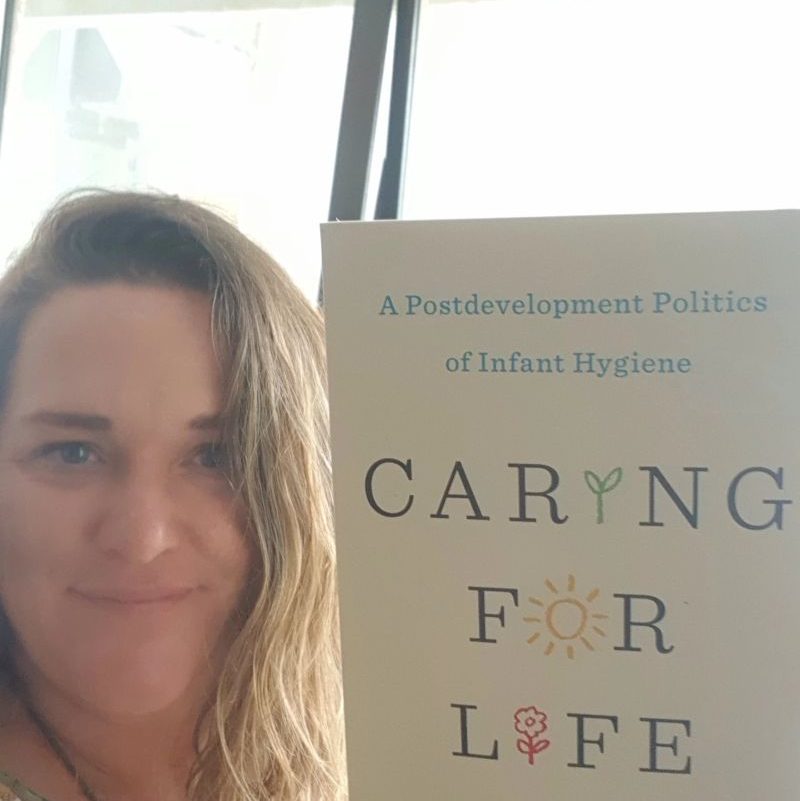
    The author holds up a copy of the book Caring for Life: a postdevelopment politics of hygiene
  • Introducing Heidi — a co-funded PhD student working on food transitions

    Introducing Heidi — a co-funded PhD student working on food transitions

    As part of my Rutherford Transitioning to Caring Economies work I look to take on students doing aligned projects funded by other funders. Heidi McLeod is a PhD student I am co-supervising enrolled at Lincoln University. She is a Food Transitions 2050 scholar, lives in Hawke’s Bay, and has participated in the research postcapitalist possibilities winter school.

    Heidi, tell us a bit about yourself and what you are working on.

    I am an out and out foodie and I love good food. I am passionate about whole food and food that comes from a quality environment. I aim to live lightly on the earth, well lighter and lighter, and I care about how our world cares for itself and each other. My immersion in Human Geography over the last few years has seen me contemplate the elements of space, place, scale, and flow. These touchstone points have helped me engage with how we live and thrive in the world today, yesterday, and tomorrow. Because I have had a lifetime connected to food, I used my geographic learnings to think about food and our food system – connecting things that I love and have meaning to me. If I can’t feed you, I have failed!

    To explore how food is in space, place, scale and flow, I have come to think about production and consumption, the ways in which food is connected across myriad places and flows, and finally settling to think about food for the people of Aotearoa New Zealand. I have been drawn to the discourse around care and ethics, recognising the importance of diversity, surplus, and the need for different political and economic mindsets to provide food to people in a way that does not limit access or cause social and environmental harm. To this end, I have begun a PhD, through the Food Transitions 2050 Joint Postgraduate School, aimed at examining the impact of local food systems and socially and environmentally just food security initiatives. I’m right at the beginning, but have a great team and I can’t wait to get started on my research and see what I can learn to share with Aotearoa New Zealand about our food system.

    What are the big transitions you see needing to happening in your area of interest?

    I’m really conscious of Aotearoa New Zealand’s colonised trajectory into agriculture, and our position within global systems as a dairy and meat exporter (alongside other smaller but lucrative produce and products) to international markets. My concern is that our national focus appears to be on taking every opportunity to maximise use of our environment to harness export or niche markets for an optimum price. However, at the same time Aotearoa New Zealand, like many other countries, is faced with complex problems of malnutrition, climate change, environmental degradation, and social inequalities which ring the alarm bell of food insecurity. This begs the question, what transitions are required to improve outcomes for Aotearoa New Zealand’s eaters and also many agricultural producers?

    This is the intersection with caring economies literature, and more specifically with the oeuvre of Gibson-Graham’s work on diverse economies. It feels to me that our current political and economic structures prioritise policy, regulation, and funding that favours and progresses our agricultural export potential ahead of attending immediate needs of Aotearoa New Zealand’s eaters and smaller producers. The fantastic fact is that we can absolutely do both, it’s not a case of ‘either-or’ but of ‘both-and’. However, in my mind, our structures of political economy need to recognise and embrace diverse and caring economies, pursuing social and environmental justice, not just export drivers. I think there is space for both and we need to transition to a place of enabling these diverse and hopeful possibilities.

    What inspires you from the communities you are working with?

    I’m not yet researching with communities for my PhD. But, based on research I’ve done in Taranaki and with food system innovators who are reinventing food supply/value chains, I’m inspired by the intuitive knowledge these growers who are working against the grain to produce amazing produce in a way that betters our environment, provides ideal livelihoods, and redistributes value to producers. They all exhibit welcome additional options to our mainstream systems and conveniences. I’m inspired by the way they can give full effect to their ideals be they cultural, environmental, or social. I’m disheartened by the challenges they face, the lack of visibility and appreciation they receive, and the barriers they face as they continue to innovate and experiment with the highest benchmarks of care and ethics. Therefore, I want to utilise my PhD and ongoing research to highlight the value of these caring economies in order to enhance policy, regulation and our lived experiences.

    What are some of the challenges in doing a PhD in this area?

    He tangata, he tangata, he tangata. There are challenges wherever you look, but with the right people on your waka you can crest any wave.

    Heidi is a food systems researcher who is passionate about local food.
  • Why we should talk about economies rather than ‘the economy’

    Why we should talk about economies rather than ‘the economy’

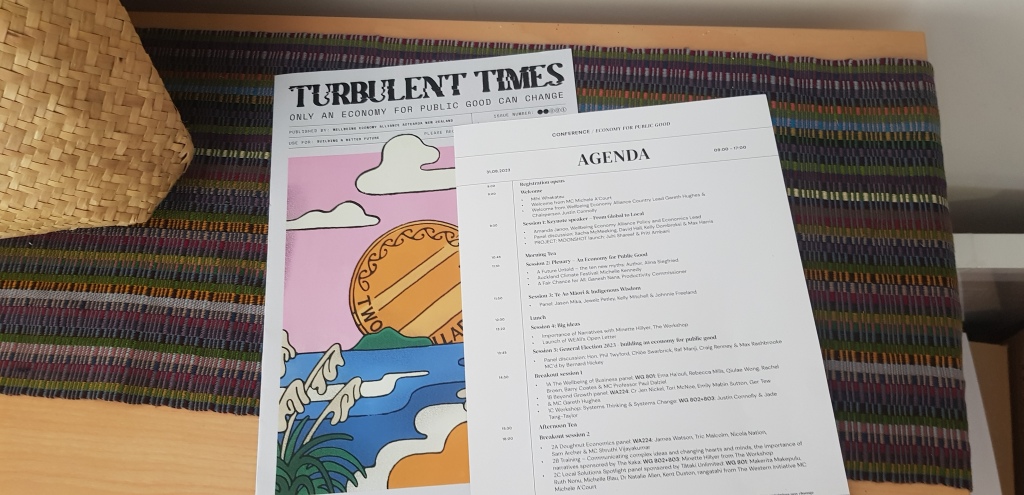
    Below is the script for my response to Amanda Janoo’s talk at the Economy for Public Good Conference, August 31st at AUT. The conference was organised by the Wellbeing Economy Alliance of Aotearoa. Thanks to Gareth Hughes for the invite.

    Tēnā koutou katoa, ngā mihi nui kia koutou.

    E ngā mana whenua o te rohe nei, ko Ngāti Whātua ki Orakei, tēnā koutou.

    E ngā kaikōrero o te ra, tēnā koutou.

    E ngā tāngata katoa kua tae mai nei kei te tautoko te kaupapa o tēnei ra, nōku te hōnore ki te tu, ki te mihi ki a koutou katoa.

    No Wairarapa ahau, he tangata tiriti ahau. No Kotiwana ōku tūpuna. E noho ana ahau ki Papaioea, e mahi ana ki Te Kunenga ki Purehūroa Massey University. Ko Kelly Dombroski tōku ingoa.

    Mauri ora ki a tātou katoa.

    Kia ora everyone, it’s such an honour to be here today with all of you at this event looking at wellbeing economies – and I use it in the plural – I will get back to that later.

    Amanda, thanks for your talk today laying out how we got here in terms of economic thinking and practices. There are two responses I’d like to make in support of your talk – both for situating this kaupapa in Aotearoa but also about the way we think about economies more generally.

    Have you noticed already that I’m talking about economies in the plural?

    I’m a geographer, and the big thing that we are into is this idea of ‘place’. Place matters. Where you are in the world matters. It makes a difference. And although we have experienced incredible globalisation of our economies in the past century, place still matters for economies. I’m going to ask for a small change to our language here today – to speak not of ‘the economy’ as if it was this big coherent immoveable and solid thing, but to speak of economies – and to speak of economies as diverse, place-based, interconnected yes, but also unique and uniquely ours.

    Even now, some of you are thinking – yes of course ‘the economy of New Zealand’. Others are thinking ‘but the system!! The system!! It’s all connected!!’. YES it is all connected, but kao, it is not one economy necessarily. We all participate in interconnected but place-based economies. As Amanda has alluded to, it is their ubiquity across the world that our hope for further change lies.

    So the first step for those of us interested in wellbeing and economies is this: to recognise the diverse range of economic activities already in play in our place-based economies. The vast majority of these economic activities lie below the waterline – that is, they are not measured by GDP, they are not studied by many economists, they are not considered when economic planners think about how we might try to secure housing or food for our whānau.  These are the gifting, social surplus, commoning, solidarity, hapū, community and volunteering economic activities – noncapitalist labour, noncapitalist enterprises, noncapitalist transactions, property and finance. These are already here if we look below the waterline. I’ve interviewed and researched dozens of community economy groups over the last decade, and done in depth studies into what they’re doing.

    For wellbeing economies in Aotearoa, the first step is to inventory what we already have in our place-based and regional economies at hand. These are like the ingredients in our pantry. We can cook up a boring meal based on one big lump of potatoes while everything else rots, or we can pull out and support all the decent ingredients that we have already at hand.

    The meal has some parameters: it has to be nutritious and filling, but it also has to meet cultural requirements of our places– to feed our guests without shame, to include important foods that have meaning to us. It has to be ethical too – to not be made up of foods that are destroying our lands and seas and peoples lives. It also has to be affordable, and hopefully to not be wasteful. The parameters of dignity, purpose, particpation, care for the natural world that Amanda mentioned are good start points. If we think of our economies as pantries rather than massive singular systems, we can also think of ourselves as ethical collective actors in our place-based economies. What meal we cook up is also a result of the decisions that we collectively make – they are not automated laws of the market or economy that force us to act to only in one way, as if we were rational economic robots constantly outsourcing the costs of our lives to others if given half a chance. We can think a bit more about what these meals might look like.

    If we think of our economies as pantries rather than massive singular systems, we can also think of ourselves as ethical collective actors in our place-based economies.

    Kelly Dombroski

    So for me – and this is my main point: we have to talk about economies in the plural, to map out the ingredients we have to work with already, to build on that and make decisions about combining these economic activities into economies at a lot of different scales and in different places around the motu. And this is what our mahi has been doing – in Ōtautahi, and now in Te Whanganui a Tara – inventorying the best ingredients that we already have and writing them up and sharing them around.

    It is about collectively working with what we have in full recognition to the diversity of answers to the question “how do we live well together”? with the answer partly being ‘start where we are, with what we have at hand’.

    Nō reira, ka tika te kōrero: mauri mahi, mauri ora – let’s be the people that do that mahi of working out how to live well together in these challenging times.