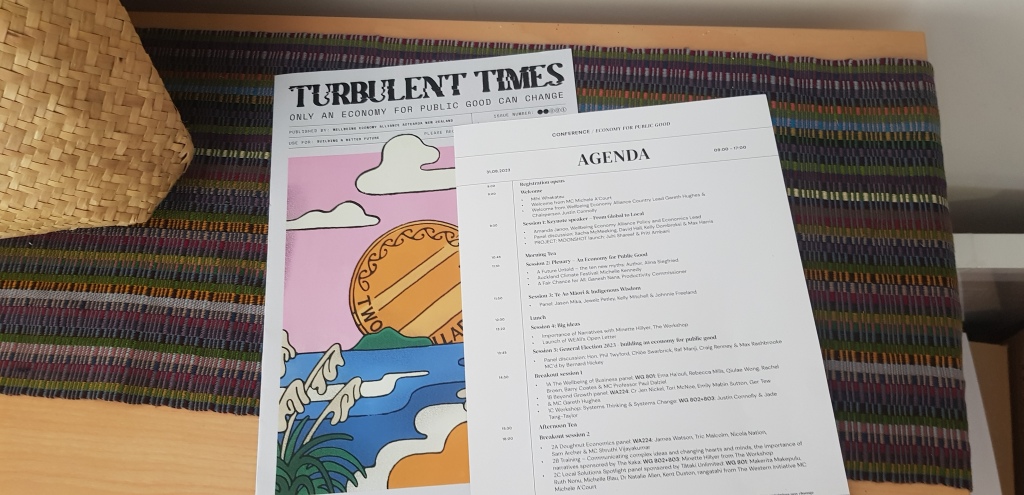
Below is the script for my response to Amanda Janoo’s talk at the Economy for Public Good Conference, August 31st at AUT. The conference was organised by the Wellbeing Economy Alliance of Aotearoa. Thanks to Gareth Hughes for the invite.
Tēnā koutou katoa, ngā mihi nui kia koutou.
E ngā mana whenua o te rohe nei, ko Ngāti Whātua ki Orakei, tēnā koutou.
E ngā kaikōrero o te ra, tēnā koutou.
E ngā tāngata katoa kua tae mai nei kei te tautoko te kaupapa o tēnei ra, nōku te hōnore ki te tu, ki te mihi ki a koutou katoa.
No Wairarapa ahau, he tangata tiriti ahau. No Kotiwana ōku tūpuna. E noho ana ahau ki Papaioea, e mahi ana ki Te Kunenga ki Purehūroa Massey University. Ko Kelly Dombroski tōku ingoa.
Mauri ora ki a tātou katoa.
Kia ora everyone, it’s such an honour to be here today with all of you at this event looking at wellbeing economies – and I use it in the plural – I will get back to that later.
Amanda, thanks for your talk today laying out how we got here in terms of economic thinking and practices. There are two responses I’d like to make in support of your talk – both for situating this kaupapa in Aotearoa but also about the way we think about economies more generally.
Have you noticed already that I’m talking about economies in the plural?
I’m a geographer, and the big thing that we are into is this idea of ‘place’. Place matters. Where you are in the world matters. It makes a difference. And although we have experienced incredible globalisation of our economies in the past century, place still matters for economies. I’m going to ask for a small change to our language here today – to speak not of ‘the economy’ as if it was this big coherent immoveable and solid thing, but to speak of economies – and to speak of economies as diverse, place-based, interconnected yes, but also unique and uniquely ours.
Even now, some of you are thinking – yes of course ‘the economy of New Zealand’. Others are thinking ‘but the system!! The system!! It’s all connected!!’. YES it is all connected, but kao, it is not one economy necessarily. We all participate in interconnected but place-based economies. As Amanda has alluded to, it is their ubiquity across the world that our hope for further change lies.
So the first step for those of us interested in wellbeing and economies is this: to recognise the diverse range of economic activities already in play in our place-based economies. The vast majority of these economic activities lie below the waterline – that is, they are not measured by GDP, they are not studied by many economists, they are not considered when economic planners think about how we might try to secure housing or food for our whānau. These are the gifting, social surplus, commoning, solidarity, hapū, community and volunteering economic activities – noncapitalist labour, noncapitalist enterprises, noncapitalist transactions, property and finance. These are already here if we look below the waterline. I’ve interviewed and researched dozens of community economy groups over the last decade, and done in depth studies into what they’re doing.
For wellbeing economies in Aotearoa, the first step is to inventory what we already have in our place-based and regional economies at hand. These are like the ingredients in our pantry. We can cook up a boring meal based on one big lump of potatoes while everything else rots, or we can pull out and support all the decent ingredients that we have already at hand.
The meal has some parameters: it has to be nutritious and filling, but it also has to meet cultural requirements of our places– to feed our guests without shame, to include important foods that have meaning to us. It has to be ethical too – to not be made up of foods that are destroying our lands and seas and peoples lives. It also has to be affordable, and hopefully to not be wasteful. The parameters of dignity, purpose, particpation, care for the natural world that Amanda mentioned are good start points. If we think of our economies as pantries rather than massive singular systems, we can also think of ourselves as ethical collective actors in our place-based economies. What meal we cook up is also a result of the decisions that we collectively make – they are not automated laws of the market or economy that force us to act to only in one way, as if we were rational economic robots constantly outsourcing the costs of our lives to others if given half a chance. We can think a bit more about what these meals might look like.
If we think of our economies as pantries rather than massive singular systems, we can also think of ourselves as ethical collective actors in our place-based economies.
Kelly Dombroski
So for me – and this is my main point: we have to talk about economies in the plural, to map out the ingredients we have to work with already, to build on that and make decisions about combining these economic activities into economies at a lot of different scales and in different places around the motu. And this is what our mahi has been doing – in Ōtautahi, and now in Te Whanganui a Tara – inventorying the best ingredients that we already have and writing them up and sharing them around.
It is about collectively working with what we have in full recognition to the diversity of answers to the question “how do we live well together”? with the answer partly being ‘start where we are, with what we have at hand’.
Nō reira, ka tika te kōrero: mauri mahi, mauri ora – let’s be the people that do that mahi of working out how to live well together in these challenging times.



 Researching Postcapitalist Possibilities
Leave a reply to Why we should talk about ‘economies’ rather than ‘the economy’ – Throwntogetherness Cancel reply